Hidden Messages in the Bible: The Genealogies in Genesis 5

Perhaps you have seen the post that claims the names of the genealogies in Genesis 5 conceal a secret message. The one I saw today had the following chart to illustrate this message. Basically, if you take the leading name of the men from Adam to Noah (Gen 5) you get the hidden message in the chart below: Man Appointed Mortal Sorrow; The Bless God Shall Come Down Teaching; His Death Shall Bring the Despairing Rest, or Comfort. The awkward grammar should be your first clue that someone is making this up.
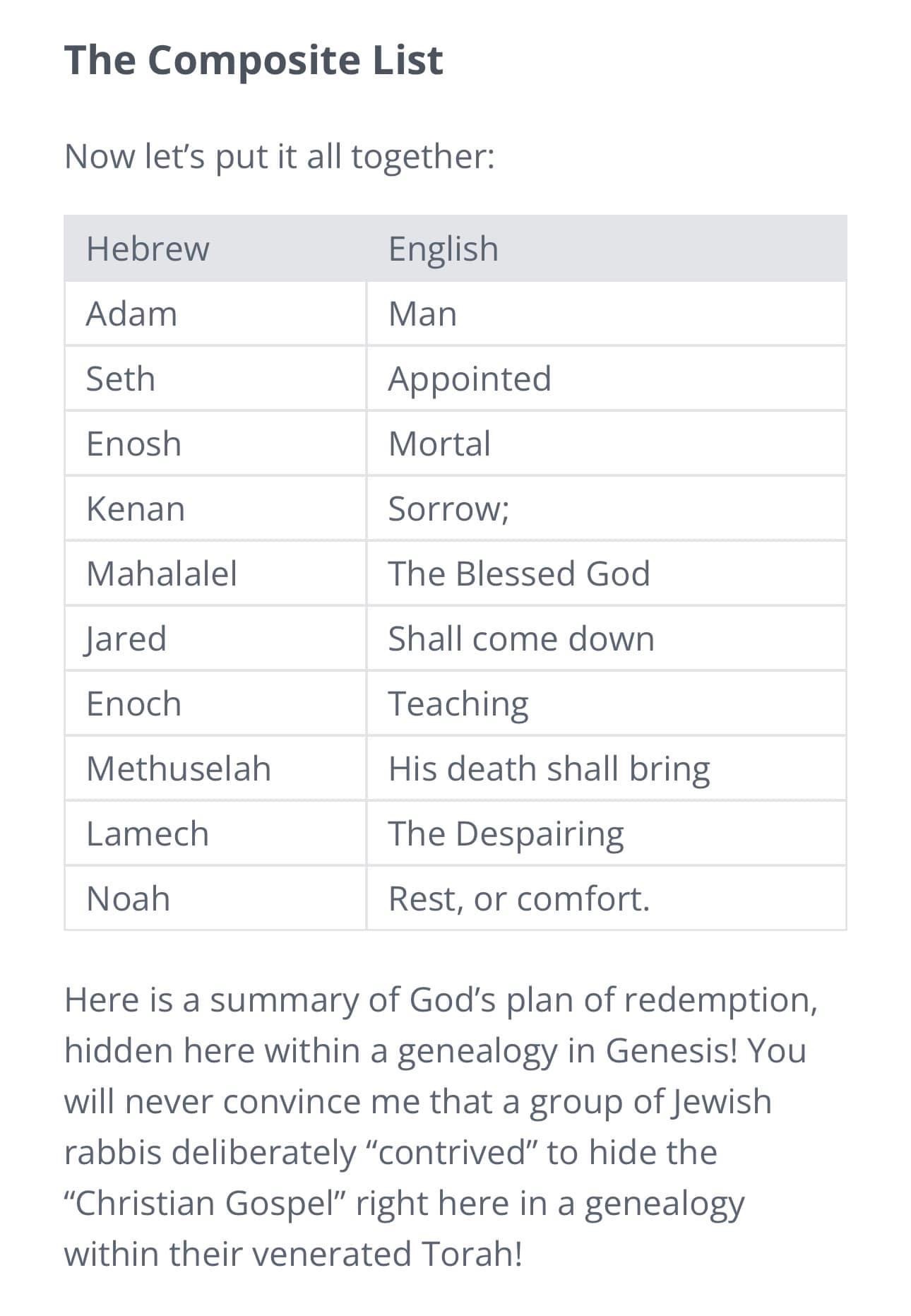
The cryptographer behind this chart is convince that God’s plan has been hidden in the names found in Genesis 5. However, that is not really how the Hebrew language works.

What the last sentence below the table means is not exactly clear. Is someone claiming that Jewish rabbis clandestinely contrived to hide the Gospel in the Torah? Why would they do that? And how could rabbis do this since Genesis 5 existed long before the time of Jesus?

To be sure, the various authors of the Hebrew Bible engaged in many different kinds of wordplays but with the intent that the reader would catch them—after all they would not be good wordplays if the reader could not share in the fun with the author. For example, one of the best wordplays shows up in the prophet Isaiah who is to called his son “Maher-Shalal-Hash-Baz” (Isa 8:1, 3) which in Hebrew means “quick to the plunder, swift to the spoils.” This is no doubt a symbolic name—can you imagine saying this name every time you called or mentioned your son?

The text, moreover, is quick to fill in the prophetic meaning: “For before the boy knows how to say ‘My father’ or ‘My mother,’ the wealth of Damascus and the plunder of Samaria will be carried off by the king of Assyria” (Isa 8:5). This is more typically what one will find in the Hebrew Bible with any “hidden” meaning, which is not so hidden. Even in Genesis, names often connect with the immediate story being told. (For an extended series of word plays, see Amos 1:8–16, where the various locations sounds like other words that show up in the nearby text).

Adam is both a proper name of the first human male and the class of being (humans) that includes both male and female (Gen 1:27; 5:2). A nice wordplay occurs in Gen 2:7 when Adam (אָדָם) is made from the dirt (adamah; אֲדָמָה). Again, this is quite typical for the Hebrew Bible. But, even at this point, this creates a problem for the chart above since “Adam” can mean human (male and females) or can be a proper name. Context is the best way to determine which connotation is most appropriate; the chart has shown one possibility in the range of meaning for this word. Here, in Gen 5:3, it is a name since it is part of an extended genealogical table.

Seth is a personal name related to the verb that means “put,” “put in place,” “established,” “constitute,” or “make something.” The context, Gen 4:25, is clear about how the wordplay works when Eve announces, “God has granted me another child in place of Abel, since Cain killed him.” Thus, God has given, put in place, a replacement for the son the first couple lost. One need make no more of this than what the text explicitly says. Furthermore, and this applies to all of the names here, no NT writer who makes the point the chart is trying to conjure.

Next, comes the name Enosh. As a noun, instead of a proper noun, it another word meaning “human.” That’s right: it’s another word for man, person, human, or human race. However, it is no more “mortal,” than say the name Adam was. Though “mortal” might be an acceptable translation if one is using the word as an equivalent to human, it is not an adjective as it is being used in the chart above, but a name.

Now, for Kenan. As a noun, this word means a dirge or elegy, a sad song. In its verbal form, it means to chant [a dirge or lament]. It would be incorrect to say that Kenan means “sorrow,” but more correctly the word is related to the noun for dirge or the verb meaning to lament. Again, as with all the names in the genealogical table in Gen 5, the author of Genesis is making a point out of this name or words that sound like it.

Mahalalel is a name that resembles the Hebrew for “praise of God,” not as the chart indicates. Again, the text itself makes no wordplays on Mahalalel, and we should probably show the same restraint. Indeed, in all the places this name shows up in the Bible (Gen. 5:12–13, 15–17; 1 Chr. 1:2; Neh. 11:4; Luke 3:37), no interpretation is ever based on the possible meanings of that name.

The same can be said of the other names in the genealogical list. So let me briefly look at the remaining names in Gen 5: Jared, Enoch, Methuselah, Lamech and Noah.

Jared’s name is similar to the verb meaning “to go down” but neither the text here nor anywhere else makes a wordplay on that name. The chart verbalizes the name to mean “shall go down,” however, if Jared’s name (יֶרֶד) were the verb (יָרַד), it would be translated “went down” (Qal verbs are generally translated in the past tense) As it is here in Gen 5, it is simply a proper name.

Likewise, Enoch’s name (ḥᵃnôḵ in Hebrew) sounds like the Hebrew word that could be translated “to educate, train up,” but could also be translated “to dedicate.” However, in the biblical text, the name refers to a son of Cain (Gen 4:17–18), a son of Midian (Gen 25:4; 1 Chron 1:33), a son of Reuben (Gen 46:9, Ex 6:14, Num 26:5, and 1 Chron 5:3), and, of course, Enoch in Gen 5 (see also 1 Chron 1:3, as well as Heb 11:5; Jude 1:14).

Methuselah is reported in Genesis to have lived the longest of any human. Of course, his father Enoch beats him by not dying at all. But does his name mean or is it related to the meaning “His Death Shall Bring”? The lexicographer (Brown, Drivers, and Briggs) are uncertain as to the exact meaning. Maybe, it echos “man of God,” or it could mean “man of the dart,” as compared to Babylonian sources. In short, no one know what the various components of the name might have meant. So the interpretation of the name in the chart above has been manufactured to fit the desired outcome.

Does Lamech have any connection to the idea of despairing? Again, lexicographers have no clue as to the “meaning” on which this name is based since the root (l-m-k) does not exist in any Western Semitic languages. In others words, outside the name Lamech no other words in Hebrew are built on this root.

Then, finally comes Noah. The name of Noah for does seem to connect to the Hebrew words of rest and comfort, but the application of that name in the context of the genealogy in Gen 5 is explicit in the words of his father Lamech: “He will comfort us in the labor and painful toil of our hands caused by the ground the LORD has cursed” (Gen 5:29). So Noah is envisioned here as a sort of “Messiah” that would somehow reverse the cursing of the ground (see Gen 3:17–18).

All these names, then, form the bridge from the earliest characters in Genesis to Noah. The names themselves are not telling a secret or hidden story but are in the service of the story actually being told in the Book of Genesis. The use of the name “Noah” and the related root nwḥ, meaning “to rest, settle down” is a great example of how the Hebrew Bible does wordplays that are intended to be picked up by the original readers but does not always survive translation into other language.

Thus, in the Flood Story, Noah (nḥ) is to bring comfort (nḥm; in a passive form, “to be sorry for”) from labour (ꜥśh) and toil (ṣb). So the story begins, “And the Lord was sorry [nḥm] that he had made [ꜥśh] man on the earth and it grieved [ꜥṣb] him to his heart”(Gen 6:6). The wordplay with nḥm continues in the next verse: “And the Lord said, ‘I will blot out [mḥh] man whom I have created” (Gen 6:7). Again, “Noah [nḥ] found favor [ḥn] in the eyes of the Lord” (Gen 6:8). Later, Noah begets a son named Ham (ḥm, Gen 6:10), sounding something like “comfort,” but also like “violence” (ḥms): “… and the earth was corrupt in the eyes of God and the earth was filled with violence [ḥms]” (Gen 6:11). “Noah” (nḥ) and “violence” (ḥms) show up again in Gen 6:13 but the wordplay extends to the word “outside” (mḥwṣ) in Gen 6:14, as Noah pitched the ark inside and outside [mḥwṣ].”

Now, the preceding is how a Hebrew wordplay works but it takes some patience and guidance to see them at work, particularly if you have never studied the Hebrew language. (My guide reading the Noah cycle was Isaac M. Kikawada, Anchor Yale Bible Dictionary, s.v., “Noah and the Ark: The Hero of the Flood”).

Now, finally, back to that chart. What more can I say?

In summary, the Bible does not communicates the message of redemption in coded words sprinkled throughout the text. Rather, the Bible is largely a narrative that tells a story. The “story” tells the “story.” While wordplays are present in the Hebrews, these are not always easily available to English readers—the narrative certainily becomes richer when we can see them, but the overarching story of Scripture is not hidden, it is right before your eyes.

The Name and the Sound of Breath

On various social media, and in sermons, and teachings, the claim is sometimes made that the Hebrew name of God equates to the sound of breathing.

That teaching goes something like this:

There was a moment when Moses had the nerve to ask God what his name is. God was gracious enough to answer, and the name he gave is recorded in the original Hebrew as YHWH.

Over time we’ve arbitrarily added an “a” and an “e” in there to get YaHWeH, presumably because we have a preference for vowels.

But scholars and Rab[b]i’s have noted that the letters YHWH represent breathing sounds, or aspirated consonants. When pronounced without intervening vowels, it actually sounds like breathing.

YH (inhale): WH (exhale).

So a baby’s first cry, his first breath, speaks the name of God.

A deep sigh calls His name – or a groan or gasp that is too heavy for mere words.

Even an atheist would speak His name, unaware that their very breathe is giving constant acknowledgment to God.

You can find this example at https://diggingdeeper.net/2022/02/17/my-very-breath/.

So, let’s dig a little deeper. It is true that God has a name in the Hebrew Bible, not just a descriptor or category (such as god [elohim], lord [adonai]). In the text where the Lord appears to Moses through a burning bush, the narrator wrote,

God [ʾᵉlōhı̂m] said to Moses, “I AM [ʾehyê] WHO I AM. This is what you are to say to the Israelites: ‘I AM has sent me to you.’ ”

God also said to Moses, “Say to the Israelites, ‘The LORD [YHWH], the God of your fathers—the God of Abraham, the God of Isaac and the God of Jacob—has sent me to you.’”

Exodus 3:14–15

Lost in English translation is that “the LORD” is hiding the name of God in Hebrew. This name is sometimes transliterated into English with the four letters, YHWH, called the Tetragrammaton in academic parlance. Though this text in Exodus introduces the name to Moses, its first appearance in the Bible is at Gen 2:4 and the name appears over 6800 times in the whole Bible.

The Greek translation of the Hebrew Bible, known as the Septuagint (abbr. LXX), translated God’s name as either “God” (θεός; theos) or “Lord” (κύριος; kurios). The latter translation begins the tradition of translating God’s name as “Lord.” The New Testament authors wrote in Greek and used the Septuagint and so consequently they speak of God as “Lord,” a term they also applied to Jesus.

Speaking of the development of the tetragrammaton, we did not somehow arbitrarily come up with the vowels between the consonants. Nor did Hebrew speakers lack a preference for vowels—it is actually hard to speak without vowels. Rather Hebrew did not express every vowel in written form—though some of the Hebrew alphabet function as vowels. In time, scribes created vowel markings so the vowels would not be forgotten as Hebrew became less used. Below I have given a copy of Gen 1:1 without and with vowels (and other diacritical markings) noted.

בראשית ברא אלהים את השמים ואת הארץ

בְּרֵאשִׁית בָּרָא אֱלֹהִים אֵת הַשָּׁמַיִם וְאֵת הָאָרֶץ

Hebrew had vowels before the vowel markers were added. But when it comes to YHWH, scholars remain uncertain exactly how this word was pronounced because the Masoretes, the scribes responsible for the vowel markings in the Hebrew Bible, used the vowels for adonai (“lord” or “master”) and would read the name as adonai or “the name” to avoid the misuse of God’s name in keeping with the third commandment. (See any standard Bible dictionary or encyclopedia for this information; e.g., I consulted Geoffrey W. Bromiley, editor, International Standard Bible Encyclopedia, rev. ed. [Grand Rapids: Eerdmans, 1982], s.v. “God”).

Instead of the sound of breathing, the name YHWH is related to the verb “to be” (הָוָה; hāwâ) in Hebrew. It would convey the sense that God is the “one who is,” thus, directly connecting to the “I am who I am,” or even “I will be who I will be” of Exodus 3:14. This link is clear and uncontested to Hebrew scholars as the footnote in the NIV 2011 points out: “The Hebrew for LORD sounds like and may be related to the Hebrew for I AM in verse 14.” Leon R. Kass, Founding God’s Nation: Reading Exodus (New Haven: Yale University Press, 2021), 73, points out that the name of God YHWH is the “correlative third-person singular, imperfect, of the same verb: ‘He is being,’ ‘He will be being.'” As a verb, YHWH would be read as “he is,” not an onomatopoeia of breathing in and out.

The Greek translation of the Hebrew Bible, the LXX dealt with the awkwardness of God announcing that his name is “I AM” in this way: Ἐγώ εἰμι ὁ ὤν, which translated would be something like “I am the being one.” Thus,” says the Lord (Κύριος), The One Who Exists (Ὁ ὢν) sent me to you.” The point is that God’s name revolves around the notion of the one who exists and who exists on God’s own terms. God’s existence, unlike our own, is not contingent or dependent on anything. God EXISTS! That is what is embedded in God’s personal name YHWH.

So who are the scholars and rabbis who say the name of God replicates the sound of breathing? You will note that in the piece cited above no bibliographic data is given and for good reason. None exists. Here you will only hear the sound of silence. You will not find this information in the Bible or any ancient Jewish source.

So take a deep breath. Now let it out, and be assured that God exists.

Does “Church” mean “the called out”?

I still hear it, though, by this time we should know better. The word “church” means “the called out,” therefore, based on the root meaning of the word, the church are the called out ones. Actually, no. While I certainly don’t want to take issue with the notion that the church should be those “called out” of the world to live God’s life for the sake of the world, the word church in the NT (ἐκκλησία) does not mean “the called out.”

This a bit like saying our English word “church” means “those belonging to the Lord,” since, after all, the English word church derives from the Greek “kurikos” (κυριακός) which meant “belonging to the Lord.” But few would even make that connection today.

D. A. Carson, years ago in Exegetical Fallacies, called this way of thinking about words, the root fallacy–that is that you can find what a word means by looking at its constituent parts (in this case, ἐκ [out of] + κλῆσις [calling]).

By the time of the first century, the word was the common word for a political or other assembly. The word, in that sense, is not a religious word. Furthermore, the import of the word is not the people had been called out but rather that they have assembled to conduct some business or activity. In one case in the NT, the word refers to a gathered mob (Acts 19:32).

Unfortunately, the often overlooked background of the NT use of the word ἐκκλησία is that the earliest Christians conversant in Greek knew the word from the Greek translation of the OT, the Septuagint (LXX). The word was not a new word for the early Christians but one they heard often with the OT was being read.

The Greek translators of the OT used the word ἐκκλησία as a translation of קָהָל (qahal) and other synonyms, generally translated as congregation or assembly. Consequently, the NT word we translate “church,” is all over the OT, as in Deut 4:10; 9:10; 18:16; 23:2-4, 9; 31:30; Josh 8:35; Judg 20:2; 21:5, 8; 1 Sam 17:47; 19:20; 1 Kings 8:14, 22, 55, 65; 1 Chr 13:2, 4; 28:2, 8; 29:1, 10, 20; 2 Chr 1:3, 5; 6:3, 12-13; 7:8; 10:3; 20:5, 14; 23:3; 28:14; 29:23, 28, 31-32; 30:2, 4, 13, 17, 23-25; Ezra 2:64; 10:1, 8, 12, 14; Neh 5:7, 13; 7:66; 8:2, 17; 13:1; Judith 6:16, 21; 7:29; 14:6; 1 Mac 2:56; 3:13; 4:59; 5:16; 14:19; Psa 21:23, 26; 25:5, 12; 34:18; 39:10; 67:27; 88:6; 106:32; 149:1; Prov 5:14; Job 30:28; Sir 15:5; 21:17; 23:24; 24:2; 26:5; 31:11; 33:19; 38:33; 39:10; 44:15; 46:7; 50:13, 20; Sol 10:6; Mic 2:5; Joel 2:16; Lam 1:10.

So better than thinking of the church as the “called out ones,” a more biblical approach would be seeing the church as the continuation of the story of God from the OT. When the early Christians heard the word ἐκκλησία, they were more likely to hear a reference to God’s gathered people.

Noah in Context

All of the hubbub about the new Noah movie has me thinking about what the Noah story was actually suppose to do in its canonical context in the “Primordial” history of Genesis (1-11). I teach a monthly class called “Re-Reading Scripture”  for those who want more than you usually get from a Sunday morning church Bible study. My hope is to give the students a touch of seminary-level education.

In a couple of recent classes, we explored the early chapters of Genesis and—as I always do—I try to stay with exegesis. In fact, what I usually want for the students is that they might experience the text in the shape they find it in their Bibles. So one of the driving questions for me is “How was this story intended to be heard as it is now–however it got here?”

I recently discovered that the narrative of Genesis 1-11 has an amazing symmetry I had never seen before.   discovered that, in fact, Genesis contains two creation stories, but I not thinking the E and J stories of the first two chapters. Rather the entire text Genesis 1-11 can be outline into two halves with the Noah story marking the second “creation” story, thus indicating that the Noah story is intentionally positioned in a much larger narrative.

First Half: Creation to the Flood (Ten Generations)

  1. Creation (1-2)
    1. Deeps (1.2)
    2. Blessing (1.22)
    3. Mandate (1.28)
    4. Food (1.29-30)
    5. Adam worked the ground (2.15)
  2. Adam and Eve Ate Fruit of the Tree (3)
    1. Fruit of the Tree (3.1-7)
    2. Nakedness Exposed (3.7)
  3. Cain Sinned and Cursed (4)
    Genealogy: Adam to Noah (5)
    Sons of God (6.1-4)

    1. Divine-human mix (6.1-2)
    2. Men of a name [Heb. shem] (6.4)
    3. Flood (6.5-7.24)

Result:  Creation Undone

Second Half: Noah to the Ancestors (Ten Generations)

  1. Re-Creation (8.1-9.17)
    1. Deeps (8.2)
    2. Blessing (8.17)
    3. Mandate (9.1-2, 7)
    4. Food (9.3)
    5. Noah worked the ground (9.20)
  2. Noah Drank Fruit of the Vine (9.18-28)
    1. Wine (9.20-21)
    2. Nakedness viewed (9.21-23)
  3. Ham Sinned and Cursed (9.25-27)
  4. Genealogy: Sons of Noah (10)
  5. Tower of Babel (11.1–9)
    1. Reach Heaven (11.4)
    2. Make a Name [shem]  (11.4)
  6. Genealogy of Shem [shem] (11.10-26

New Direction: God will make Abram’s name [shem] great (12.2)

Though I liked to say I discovered this on my own, I did not. I found it in Barry L. Bandstra, Reading the Old Testament: Introduction to the Hebrew Bible (4th ed.; Belmont, Calif.: Wadworth 2009), 73. If it goes back to earlier Old Testament scholars, he does not say.

This outline did a couple of things for me. First, it shows that Genesis 1-11 can be read as a unified narrative rather than a patch work of  pieces from a variety of sources. This not to deny that such is the case, but only that—in final analysis—the text has a cohesiveness and a logic that argues for intentionality in arrangement.

More importantly, as a unified narrative, the Noah story is but a piece of the overall goal of the text. In this reading, the Noah story represents a second act on the part of God to set his rather feisty creatures in the right direction. The text argues that though God gave humans a second chance, they nonetheless returned to old habits, dispositions, and inclinations. The Noah stor, from this vantage point, is a retelling of the Adam and Eve saga. The outcome of both is nakedness. They, Adam, Eve, and Noah, are exposed for who they really are and it’s not good.

Finally, the  story of Noah is framed as a story of grace (I know a lot of folks died). But the Noah story represents a new beginning for humanity, the real “grace” in the story is not human response to divine gracy but rather God’s decisions to forgo another cleansing, but rather to work slowly with his creation by choosing one person (Shem) the then work through his family (Abraham’s) to accomplish God’s goals.

Against the other “Noah stories” available in the ancient near east, the biblical Noah story had a particular tale to tell but the story did not end in itself.

Re-Dis-Orientation

Old Testament theologian Walter Brueggemann has devised a simple but deep way to categorize the Psalms that has real applicability to life. He suggests that most psalms will fall in one of the following three categories: Orientation, Disorientation, and Reorientation. While wordy, perhaps, these labels are very helpful in understanding life. In some Psalms life is good and as it should be, in others psalms life is chaotic, hard, and confusing, and in yet other psalms life is experienced as new beginning, renewal, and moving beyond. Sometimes all three of these can show up in the same psalm, as with Psa 23. The Biblical story resounds with this rhythm. Notice the following examples:

Exodus:           Egypt ➤ Wilderness ➤ Promised Land

Exile:                           In the Land ➤ Exiled in Babylon ➤ Return to the Land

Jesus:                                      Life ➤ Death and Burial ➤ Resurrection

Christians                                            Old Life ➤ Repentance ➤ New Life

What is common to all of these stories is the movement through orientation, disorientation, and into reorientation. Also common is that no one really likes being in the middle phase of disorientation.

William Bridges, in an insightful little book called Transitions: Making Sense of Life Changes, points out that all transitions in life have three basic phrases: the “old,” the “new,” and the “in-between,” this last one Bridges himself calls the “neutral zone.” The old is when life is what life is and we are not complaining because it’s normal. Then something will happen, a death, a divorce, a new opportunity, which changes our old comfortable world. The in-between is uncomfortable because it is no longer the “old,” but neither is it quite yet the “new.” However, this neutral zone of disorientation can be just what we need to grow, to come to new understandings, to get out of old ruts, etc. For some this in-between time can be excruciatingly painful. But often disorientation, in time, gives way to reorientation: a death becomes sweet memories; a loss gives way to new gains; and that which was old is given new life.

Personally, I have found thinking of life in terms of these three categories helpful. I experience life sometimes, as it should be. Things are in place. Life is good. Psalm 23 is true and the Lord really is my shepherd. However, sometimes, and more times than I would like perhaps, life is hard, disconnected, chaotic. With Psalm 23 I walk through the deepest, darkest valley. I don’t like those times but I do usually grow closer to God through them. Then disorientation gives way to new life and I find, again with Psalm 23, a table prepared before me, my head anointed and my cup full, desiring nothing more than to live in God’s house forever.

Lent is the perfect time to reflect on this. Lent is the “neutral zone” between Advent and Resurrection Sunday. You therefore might find the language of orientation, disorientation, and reorientation useful even now.

For further reading, see Walter Brueggemann’s Psalms: A Theological Commentary (Minneapolis: Augsburg, 1994) and Spirituality of the Psalms (Minneapolis: Fortress, 2002); William Bridges, Transitions: Making Sense of Life’s Changes (2nd ed.; Cambridge, Mass.: De Capo, 2004).

Copied from http://www.fcchammond.org/MAROUTLOOK2013.aspx.

Who Do You Think You Are?

Psalms 8 begins and ends as a psalm of praise to God; however, in the middle there is a strange, unexpected shift—it is almost as if this psalm praises humanity.

The moves of this psalm are easy to track.

The majesty of God! (v. 1)

The reign of God (v. 1a-2)

The Wonder of Creation (v. 3)

The Wonder of Humanity (v.4-5)

The reign of Man (v. 6-8)

The majesty of God! (v. 9)

We have already noticed that this psalm is wrapped in praise to God. God’s name, thus, his person, is magnificent, excellent, splendid! There is no doubt to the psalmist who is worthy of praise, for God has set his glory in the heavens, the created order of the universe. Even children and enemies acknowledge this. The works of his fingers include the moon and stars, and yet . . .

If God rules the heavens, then man rules—yes, that is the right word (v. 6)—over the earth. Everything is “under his feet”: animals, birds, and fish—the works of God’s hands are now under man’s feet, yet . . .

Why? Because as the psalmist ponders, “What is man that you are mindful of him, the son of many that you care for him?” The parallelism points to the simple question: “Why would God care for us?” I really want to know the answer to this one. Yet . . .

When we hear the answer, it is not what most of us expect. To me, “because he loved us,” while still not explaining it, helps a little. Yet what the Holy Spirit says through David is beyond belief. You see, God made humans in the created order to be “lower than the heavenly beings; God gave humans “glory and honor.” Yet . . .

Even the translators had trouble with what this text actually declares. “Heavenly beings” is the Hebrew word for “God.” There is no real reason to not translate the word as God here, unless you believe God would not think that highly of humans.

So the next time someone asks you, “Who do you think you are?” you can answer them, “Just below God.”

In the Center

When we leave the world of right living in the first Psalm, where the wicked blow away like chaff but the righteous stand strong like a tree, we come to the disorienting world of the second psalm. Here the outer world is in chaos. Kings and rulers are revolting against the Lord and his anointed one. Makes one wonder what kind of world is this of which this psalm speaks. However, the psalms affirms the King remains in the center.

This psalm divides into three parts:

Rulers seek to overthrow God’s rule (vv. 1-3)

Yet God still appoints his king (vv. 4-9)

Rulers had better seek God’s rule (vv. 10-12)

On one edge of this text there is conspiring, plotting, revolt. On the other, there is fear, trembling, anger, and potential destruction. Scholars believe that this psalm might have been used when a new king was being installed in ancient Israel. During regal transitions from the old king to the new king, subject nations would sometime use the occasion to gain their freedom. That seems to be the picture here.

It is time to install a new king, and Israel’s vassal nations are considering revolt. So they “take their stand against the “Lord and his anointed one.” This last reference is to the king of Israel (or Judah later on) in the original context. The vassal kingdoms seek to release themselves from their bondage (“chains” and “fetters”).

HOWEVER, in heaven, God can only laugh at their feeble attempts. God’s will will be done. His king has been installed on Zion, this king will inherit, the earth, and will rule the world with an iron scepter.

Therefore, the kings of the earth will do well to pay homage to the king: “Kiss the son!” calls the psalmist.

When the king is installed, he is recognized as “God’s son.” (cf. 2 Sam 7:12–16; 1 Chr 17:10–14). This language was common in the ancient world where several cultures consider their king somehow the son of their God. But more importantly, for us, it points to the role that Jesus would play as God’s son and our king.

So, remember, when life is disorienting on the edges, our king reigns in the center where God is.