Hidden Messages in the Bible: The Genealogies in Genesis 5

Perhaps you have seen the post that claims the names of the genealogies in Genesis 5 conceal a secret message. The one I saw today had the following chart to illustrate this message. Basically, if you take the leading name of the men from Adam to Noah (Gen 5) you get the hidden message in the chart below: Man Appointed Mortal Sorrow; The Bless God Shall Come Down Teaching; His Death Shall Bring the Despairing Rest, or Comfort. The awkward grammar should be your first clue that someone is making this up.
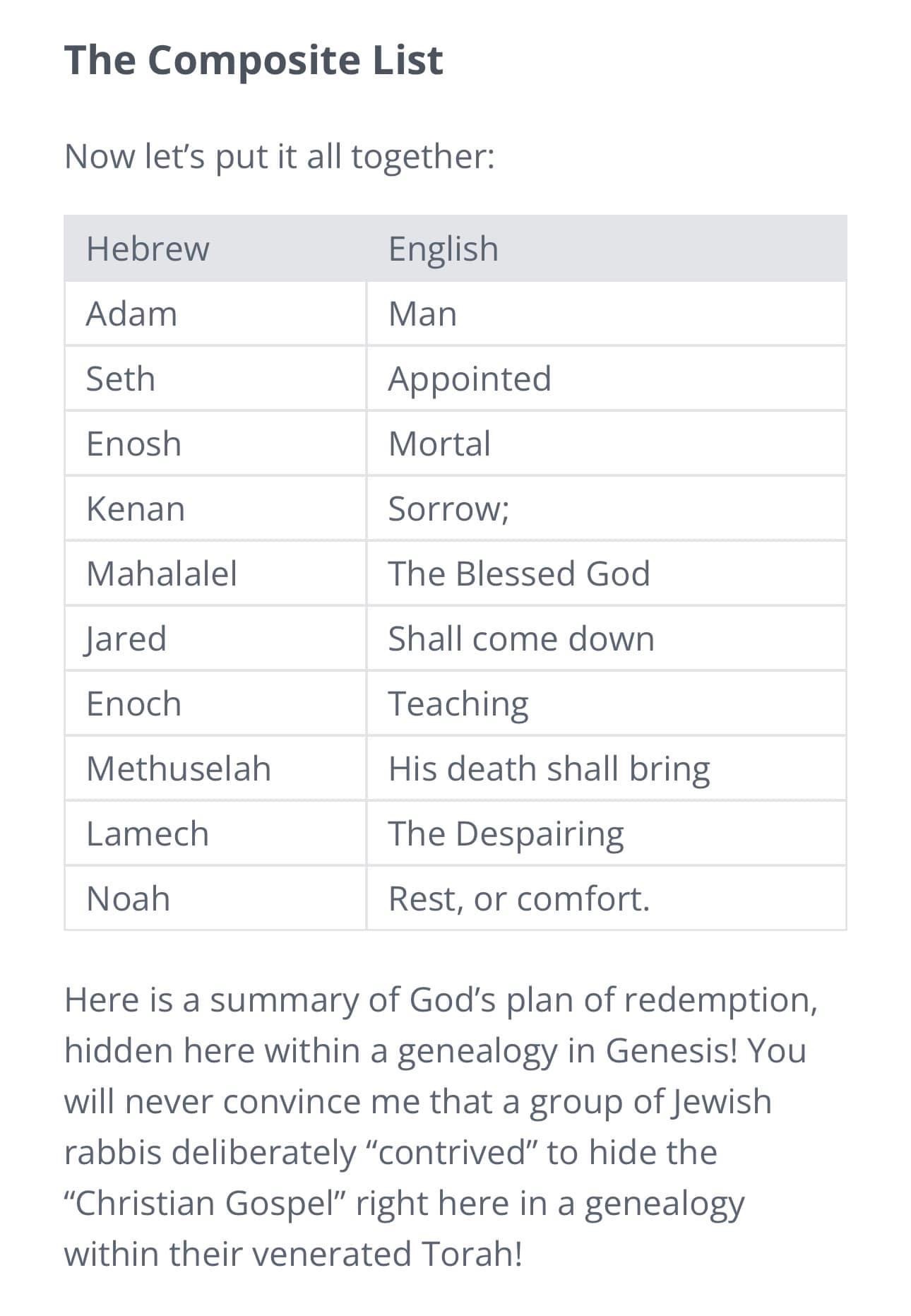
The cryptographer behind this chart is convince that God’s plan has been hidden in the names found in Genesis 5. However, that is not really how the Hebrew language works.

What the last sentence below the table means is not exactly clear. Is someone claiming that Jewish rabbis clandestinely contrived to hide the Gospel in the Torah? Why would they do that? And how could rabbis do this since Genesis 5 existed long before the time of Jesus?

To be sure, the various authors of the Hebrew Bible engaged in many different kinds of wordplays but with the intent that the reader would catch them—after all they would not be good wordplays if the reader could not share in the fun with the author. For example, one of the best wordplays shows up in the prophet Isaiah who is to called his son “Maher-Shalal-Hash-Baz” (Isa 8:1, 3) which in Hebrew means “quick to the plunder, swift to the spoils.” This is no doubt a symbolic name—can you imagine saying this name every time you called or mentioned your son?

The text, moreover, is quick to fill in the prophetic meaning: “For before the boy knows how to say ‘My father’ or ‘My mother,’ the wealth of Damascus and the plunder of Samaria will be carried off by the king of Assyria” (Isa 8:5). This is more typically what one will find in the Hebrew Bible with any “hidden” meaning, which is not so hidden. Even in Genesis, names often connect with the immediate story being told. (For an extended series of word plays, see Amos 1:8–16, where the various locations sounds like other words that show up in the nearby text).

Adam is both a proper name of the first human male and the class of being (humans) that includes both male and female (Gen 1:27; 5:2). A nice wordplay occurs in Gen 2:7 when Adam (אָדָם) is made from the dirt (adamah; אֲדָמָה). Again, this is quite typical for the Hebrew Bible. But, even at this point, this creates a problem for the chart above since “Adam” can mean human (male and females) or can be a proper name. Context is the best way to determine which connotation is most appropriate; the chart has shown one possibility in the range of meaning for this word. Here, in Gen 5:3, it is a name since it is part of an extended genealogical table.

Seth is a personal name related to the verb that means “put,” “put in place,” “established,” “constitute,” or “make something.” The context, Gen 4:25, is clear about how the wordplay works when Eve announces, “God has granted me another child in place of Abel, since Cain killed him.” Thus, God has given, put in place, a replacement for the son the first couple lost. One need make no more of this than what the text explicitly says. Furthermore, and this applies to all of the names here, no NT writer who makes the point the chart is trying to conjure.

Next, comes the name Enosh. As a noun, instead of a proper noun, it another word meaning “human.” That’s right: it’s another word for man, person, human, or human race. However, it is no more “mortal,” than say the name Adam was. Though “mortal” might be an acceptable translation if one is using the word as an equivalent to human, it is not an adjective as it is being used in the chart above, but a name.

Now, for Kenan. As a noun, this word means a dirge or elegy, a sad song. In its verbal form, it means to chant [a dirge or lament]. It would be incorrect to say that Kenan means “sorrow,” but more correctly the word is related to the noun for dirge or the verb meaning to lament. Again, as with all the names in the genealogical table in Gen 5, the author of Genesis is making a point out of this name or words that sound like it.

Mahalalel is a name that resembles the Hebrew for “praise of God,” not as the chart indicates. Again, the text itself makes no wordplays on Mahalalel, and we should probably show the same restraint. Indeed, in all the places this name shows up in the Bible (Gen. 5:12–13, 15–17; 1 Chr. 1:2; Neh. 11:4; Luke 3:37), no interpretation is ever based on the possible meanings of that name.

The same can be said of the other names in the genealogical list. So let me briefly look at the remaining names in Gen 5: Jared, Enoch, Methuselah, Lamech and Noah.

Jared’s name is similar to the verb meaning “to go down” but neither the text here nor anywhere else makes a wordplay on that name. The chart verbalizes the name to mean “shall go down,” however, if Jared’s name (יֶרֶד) were the verb (יָרַד), it would be translated “went down” (Qal verbs are generally translated in the past tense) As it is here in Gen 5, it is simply a proper name.

Likewise, Enoch’s name (ḥᵃnôḵ in Hebrew) sounds like the Hebrew word that could be translated “to educate, train up,” but could also be translated “to dedicate.” However, in the biblical text, the name refers to a son of Cain (Gen 4:17–18), a son of Midian (Gen 25:4; 1 Chron 1:33), a son of Reuben (Gen 46:9, Ex 6:14, Num 26:5, and 1 Chron 5:3), and, of course, Enoch in Gen 5 (see also 1 Chron 1:3, as well as Heb 11:5; Jude 1:14).

Methuselah is reported in Genesis to have lived the longest of any human. Of course, his father Enoch beats him by not dying at all. But does his name mean or is it related to the meaning “His Death Shall Bring”? The lexicographer (Brown, Drivers, and Briggs) are uncertain as to the exact meaning. Maybe, it echos “man of God,” or it could mean “man of the dart,” as compared to Babylonian sources. In short, no one know what the various components of the name might have meant. So the interpretation of the name in the chart above has been manufactured to fit the desired outcome.

Does Lamech have any connection to the idea of despairing? Again, lexicographers have no clue as to the “meaning” on which this name is based since the root (l-m-k) does not exist in any Western Semitic languages. In others words, outside the name Lamech no other words in Hebrew are built on this root.

Then, finally comes Noah. The name of Noah for does seem to connect to the Hebrew words of rest and comfort, but the application of that name in the context of the genealogy in Gen 5 is explicit in the words of his father Lamech: “He will comfort us in the labor and painful toil of our hands caused by the ground the LORD has cursed” (Gen 5:29). So Noah is envisioned here as a sort of “Messiah” that would somehow reverse the cursing of the ground (see Gen 3:17–18).

All these names, then, form the bridge from the earliest characters in Genesis to Noah. The names themselves are not telling a secret or hidden story but are in the service of the story actually being told in the Book of Genesis. The use of the name “Noah” and the related root nwḥ, meaning “to rest, settle down” is a great example of how the Hebrew Bible does wordplays that are intended to be picked up by the original readers but does not always survive translation into other language.

Thus, in the Flood Story, Noah (nḥ) is to bring comfort (nḥm; in a passive form, “to be sorry for”) from labour (ꜥśh) and toil (ṣb). So the story begins, “And the Lord was sorry [nḥm] that he had made [ꜥśh] man on the earth and it grieved [ꜥṣb] him to his heart”(Gen 6:6). The wordplay with nḥm continues in the next verse: “And the Lord said, ‘I will blot out [mḥh] man whom I have created” (Gen 6:7). Again, “Noah [nḥ] found favor [ḥn] in the eyes of the Lord” (Gen 6:8). Later, Noah begets a son named Ham (ḥm, Gen 6:10), sounding something like “comfort,” but also like “violence” (ḥms): “… and the earth was corrupt in the eyes of God and the earth was filled with violence [ḥms]” (Gen 6:11). “Noah” (nḥ) and “violence” (ḥms) show up again in Gen 6:13 but the wordplay extends to the word “outside” (mḥwṣ) in Gen 6:14, as Noah pitched the ark inside and outside [mḥwṣ].”

Now, the preceding is how a Hebrew wordplay works but it takes some patience and guidance to see them at work, particularly if you have never studied the Hebrew language. (My guide reading the Noah cycle was Isaac M. Kikawada, Anchor Yale Bible Dictionary, s.v., “Noah and the Ark: The Hero of the Flood”).

Now, finally, back to that chart. What more can I say?

In summary, the Bible does not communicates the message of redemption in coded words sprinkled throughout the text. Rather, the Bible is largely a narrative that tells a story. The “story” tells the “story.” While wordplays are present in the Hebrews, these are not always easily available to English readers—the narrative certainily becomes richer when we can see them, but the overarching story of Scripture is not hidden, it is right before your eyes.

Jesus, Sinners, and Repentance

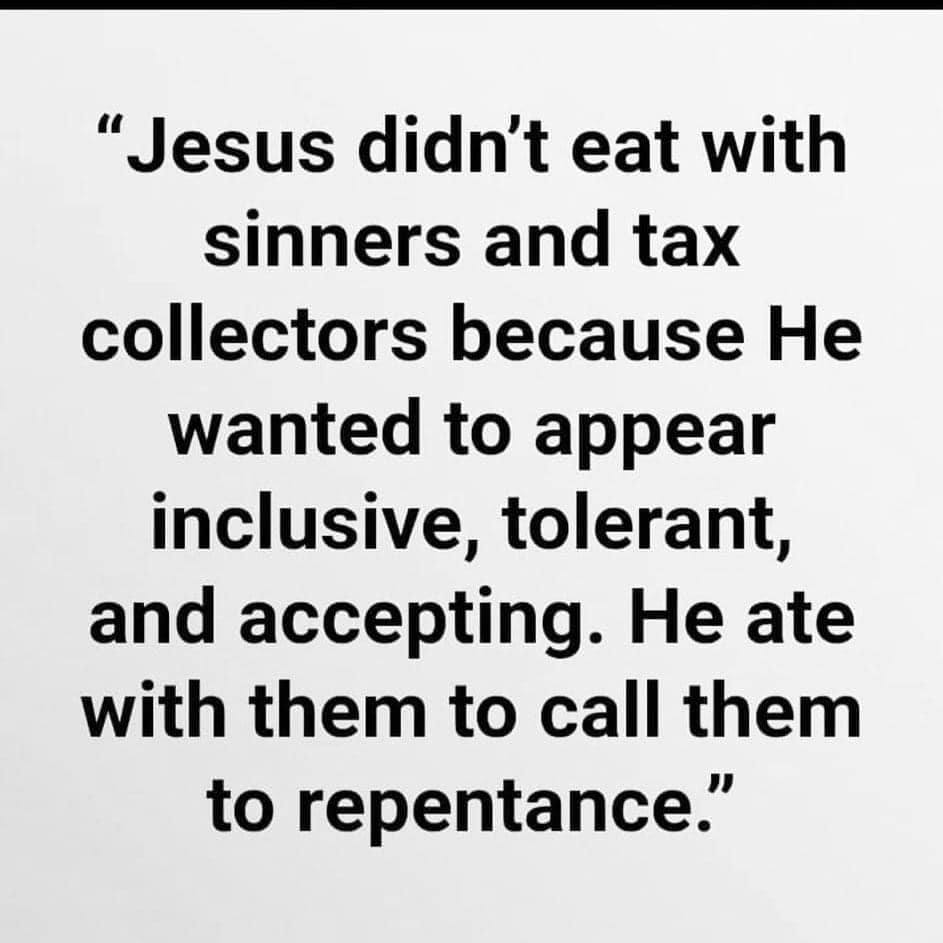
A popular meme on social media seeks to clear up Jesus’s true relationship with sinners and tax collectors. Perhaps you have seen it:

Jesus didn’t eat with sinners and tax collectors because He wanted to appear inclusive, tolerant, and accepting. He ate with them to call them to repentance.

Facebook Meme

At first glance, it seems right, particularly because it gets us past the all-in sloppy inclusiveness of our times. However, upon closer examination, it’s actually a clever cover for intolerance and inhospitality in the name of Jesus. Jesus did want to appear inclusive, tolerant, and accepting. It’s the Good News of the Gospel. Jesus welcomes sinners and even eats with them!

I do not contest that Jesus is calling all to repent. It, too, is core to the Gospel message and is the appropriate response to that message. However, I push back on the point that Jesus “did not want to appear inclusive, tolerant, and accepting.” The approach of the meme is a subtle form of gatekeeping—a way of holding those who don’t repent, to my satisfaction or my standard, at bay.

Whoever wrote the meme has no way of actually knowing whether appearing tolerant was one of Jesus’s concerns. However, in story after story in the Gospels Jesus was inclusive, tolerant, and accepting—which is precisely why religious leaders did not include, tolerate, and accept Jesus. And exactly what the sinners found so attractive in Jesus.

Though many stories can illustrate the point, I have chosen the cluster of stories in Luke 15. Here we have some of Jesus’s most well-known parables: the parable of the lost sheep, the lost coin, and what is classically known as the parable of the prodigal son (a poor title at best). To understand these stories in context, one must hear the background offered at the beginning of Luke 15:

Now the tax collectors and sinners were all gathering around to hear Jesus. But the Pharisees and the teachers of the law muttered, “This man welcomes sinners and eats with them.”

Luke 15:1–2 NIV2011

The religious leaders criticized Jesus for not just appearing so but for actually being “inclusive, tolerant, and accepting.” The leaders are disturbed because that is what Jesus did.

The parables that follow the opening verses are addressed not to the crowds in general, but specifically the Pharisees and the teachers of the law. Luke is clear, “Then he told them this parable” (Luke 15:3).

Once this is clear, the referents in the parables become quite clear: lost sheep (sinners), ninety-nine sheep (religious leaders), the shepherd (Jesus). One will note that Jesus is being playful here with the ninety-nine who have no need to repent. Doesn’t everyone have a need to repent?

Now the next parable echoes the first, is connected (“Or suppose…”), and is as transparent: lost coin (sinners), 9 coins (religious leaders), the woman (Jesus).

In both parables, the shepherd and the woman go to great lengths to find that which is lost. The religious leaders, like the author of the meme, do little to create an environment where that which is lost might be found.

Not surprisingly, the parable that follows, which I like to call, “The Parable of the Good, Good Father,” carries on with the same referents: lost son (sinners), older brother (religious leaders), the father (Jesus/God). This parable, however, ends with the judgement of the one who is unwilling to accept the younger son. The older brother will not include, tolerate, or accept his younger brother. Thus, the parable ends with the older brother impenitent.

The older brother in the story is put off by the father’s lavish, generous, outlandish display of grace and welcome: the best robe, ring on his finger, sandals on his feet, a tender calf for the feast, music and dancing—over the top celebration!

To be sure, the young son repented—well, he came home, at least. However, we should not forget that Jesus told the parables to the Pharisees and teachers of the law to explain why he was eating with tax collectors and sinners. The meme creates a false dichotomy. Truly Jesus did want to appear “inclusive, tolerant, and accepting.” He also sought to call people to repentance. These are not mutually exclusive.

It was in being inclusive, tolerant, and accepting, that Jesus gained the right to be heard by sinners and tax collectors. Jesus did not call people while standing on the outside but rather as part of them, among them. Unlike the religious leaders who feared being contaminated by the sinners, Jesus did not do it at arm’s length. He risked appearing contaminated to others so that he could make a difference among sinners and tax collectors.

We need to be less concerned about how we might appear and more concerned about those whom Jesus was willing to include, tolerate, and accept. It’s hard to maintain boundaries and be among the people at the same time.

The Name and the Sound of Breath

On various social media, and in sermons, and teachings, the claim is sometimes made that the Hebrew name of God equates to the sound of breathing.

That teaching goes something like this:

There was a moment when Moses had the nerve to ask God what his name is. God was gracious enough to answer, and the name he gave is recorded in the original Hebrew as YHWH.

Over time we’ve arbitrarily added an “a” and an “e” in there to get YaHWeH, presumably because we have a preference for vowels.

But scholars and Rab[b]i’s have noted that the letters YHWH represent breathing sounds, or aspirated consonants. When pronounced without intervening vowels, it actually sounds like breathing.

YH (inhale): WH (exhale).

So a baby’s first cry, his first breath, speaks the name of God.

A deep sigh calls His name – or a groan or gasp that is too heavy for mere words.

Even an atheist would speak His name, unaware that their very breathe is giving constant acknowledgment to God.

You can find this example at https://diggingdeeper.net/2022/02/17/my-very-breath/.

So, let’s dig a little deeper. It is true that God has a name in the Hebrew Bible, not just a descriptor or category (such as god [elohim], lord [adonai]). In the text where the Lord appears to Moses through a burning bush, the narrator wrote,

God [ʾᵉlōhı̂m] said to Moses, “I AM [ʾehyê] WHO I AM. This is what you are to say to the Israelites: ‘I AM has sent me to you.’ ”

God also said to Moses, “Say to the Israelites, ‘The LORD [YHWH], the God of your fathers—the God of Abraham, the God of Isaac and the God of Jacob—has sent me to you.’”

Exodus 3:14–15

Lost in English translation is that “the LORD” is hiding the name of God in Hebrew. This name is sometimes transliterated into English with the four letters, YHWH, called the Tetragrammaton in academic parlance. Though this text in Exodus introduces the name to Moses, its first appearance in the Bible is at Gen 2:4 and the name appears over 6800 times in the whole Bible.

The Greek translation of the Hebrew Bible, known as the Septuagint (abbr. LXX), translated God’s name as either “God” (θεός; theos) or “Lord” (κύριος; kurios). The latter translation begins the tradition of translating God’s name as “Lord.” The New Testament authors wrote in Greek and used the Septuagint and so consequently they speak of God as “Lord,” a term they also applied to Jesus.

Speaking of the development of the tetragrammaton, we did not somehow arbitrarily come up with the vowels between the consonants. Nor did Hebrew speakers lack a preference for vowels—it is actually hard to speak without vowels. Rather Hebrew did not express every vowel in written form—though some of the Hebrew alphabet function as vowels. In time, scribes created vowel markings so the vowels would not be forgotten as Hebrew became less used. Below I have given a copy of Gen 1:1 without and with vowels (and other diacritical markings) noted.

בראשית ברא אלהים את השמים ואת הארץ

בְּרֵאשִׁית בָּרָא אֱלֹהִים אֵת הַשָּׁמַיִם וְאֵת הָאָרֶץ

Hebrew had vowels before the vowel markers were added. But when it comes to YHWH, scholars remain uncertain exactly how this word was pronounced because the Masoretes, the scribes responsible for the vowel markings in the Hebrew Bible, used the vowels for adonai (“lord” or “master”) and would read the name as adonai or “the name” to avoid the misuse of God’s name in keeping with the third commandment. (See any standard Bible dictionary or encyclopedia for this information; e.g., I consulted Geoffrey W. Bromiley, editor, International Standard Bible Encyclopedia, rev. ed. [Grand Rapids: Eerdmans, 1982], s.v. “God”).

Instead of the sound of breathing, the name YHWH is related to the verb “to be” (הָוָה; hāwâ) in Hebrew. It would convey the sense that God is the “one who is,” thus, directly connecting to the “I am who I am,” or even “I will be who I will be” of Exodus 3:14. This link is clear and uncontested to Hebrew scholars as the footnote in the NIV 2011 points out: “The Hebrew for LORD sounds like and may be related to the Hebrew for I AM in verse 14.” Leon R. Kass, Founding God’s Nation: Reading Exodus (New Haven: Yale University Press, 2021), 73, points out that the name of God YHWH is the “correlative third-person singular, imperfect, of the same verb: ‘He is being,’ ‘He will be being.'” As a verb, YHWH would be read as “he is,” not an onomatopoeia of breathing in and out.

The Greek translation of the Hebrew Bible, the LXX dealt with the awkwardness of God announcing that his name is “I AM” in this way: Ἐγώ εἰμι ὁ ὤν, which translated would be something like “I am the being one.” Thus,” says the Lord (Κύριος), The One Who Exists (Ὁ ὢν) sent me to you.” The point is that God’s name revolves around the notion of the one who exists and who exists on God’s own terms. God’s existence, unlike our own, is not contingent or dependent on anything. God EXISTS! That is what is embedded in God’s personal name YHWH.

So who are the scholars and rabbis who say the name of God replicates the sound of breathing? You will note that in the piece cited above no bibliographic data is given and for good reason. None exists. Here you will only hear the sound of silence. You will not find this information in the Bible or any ancient Jewish source.

So take a deep breath. Now let it out, and be assured that God exists.

Did Jesus Fold the Cloth in His Tomb? The Myth of the Napkin in the Tomb

Around Easter every year, this little tale surfaces in various places on social media about the importance of Jesus folding the cloth that was about his head (John 20:1–10). The story goes something like this:

In order to understand the significance of the folded napkin, we need to understand a little bit about Hebrew tradition of that day. The folded napkin had to do with the master and servant, and every Jewish boy knew this tradition. When the servant set the dinner table for the master, he made sure that it was exactly the way the master wanted it. The table was furnished perfectly, and then the servant would wait, just out of sight, until the master had finished eating.

The servant would not dare touch the table until the master was finished. Now if the master was finished eating, he would rise from the table, wipe his fingers and mouth, clean his beard, and wad up the napkin and toss it onto the table. The servant would then know to clear the table. For in those days, the wadded napkin meant, “I’m finished.”

But if the master got up from the table, folded his napkin and laid it beside his plate, the servant would not dare touch the table, because the folded napkin meant, “I’m coming back!”

Let us be reminded daily during this post-Easter season, Jesus Christ is “Not Finished.” He is coming back for his faithful servants within his Church.

https://www.citizen-times.com/story/life/2017/04/21/devotional-why-did-jesus-fold-napkin-tomb/100612470/ as one example.

A couple of things should catch the attention of a discerning reader of Scripture. John does not make this interpretation but rather leaves the incident for his readers to ponder. And, secondly, the tomb of Jesus was not a dining table and Jesus’s burial cloth was not a napkin. This so-called tradition of setting aside the napkin to indicate the master would be coming back simply does not exist in Jewish tradition. Let’s look at each of these in turn.

The author of the Gospel of John had a very different reason for telling this story and reading the text of the Gospel of John carefully brings this to the forefront. Here is the text:

So Peter and the other disciple started for the tomb. Both were running, but the other disciple outran Peter and reached the tomb first. He bent over and looked in at the strips of linen lying there but did not go in. Then Simon Peter came along behind him and went straight into the tomb. He saw the strips of linen lying there, as well as the cloth that had been wrapped around Jesus’ head. The cloth was still lying in its place, separate from the linen. Finally the other disciple, who had reached the tomb first, also went inside. He saw and believed. (They still did not understand from Scripture that Jesus had to rise from the dead.)

John 20:3–9 NIV2011

John (the other disciple) had reached the tomb first, and it was John who made the correct logical deduction as to why the garments were there. “He saw and believed,” to which the narrative adds “They did not understand from Scripture that Jesus had to rise from the dead.”

For the Gospel writer, the deduction was logical and natural. The burial garments pointed to one clear fact: Jesus had risen from the dead (and this was in accordance with Scripture). The author makes no extended metaphorical application to a napkin on the table. They are what they are purported to be: burial garments without a corpse.

Just to cover the topic fully, let’s start with the particular words used for the materials in the text.

The word for the cloth that covered the body of Jesus is othonion (ὀθόνιον), which means cloth or cloth wrapping, generally of linen. In the context of John, we are speaking of burial wrappings.

The more important term in this conversation is soudarion (σουδάριον), which refers to a facecloth often used for wiping away perspiration. Interestingly, this is a word borrowed from the Latin (sudairium) which was, in fact, used for wiping the face of sweat. Conveniently, it would be comparable in size to what we today call a napkin. More problematic is the participle describing the cloth which was set apart from the larger linen cloth. John describes it as being “wrapped around,” even, twisted or rolled. “Folded” is not the meaning of this word (though a few newer translations goes in that direction). Louw and Nida in their lexicon underscore the meaning as “to enclose an object by winding something about or around it — ‘to wrap, to bandage.’” or “to cause something to be in the shape of a roll — ‘to roll up, to make into a roll.” So in the end, the cloth was not folded, but still retained the shape of being wrapped around something. The KJV has it right with “wrapped together.”

Now, the move from a head cloth in a tomb to a napkin on the table is unwarranted because there is no such Jewish tradition as so stated in the urban legend.

I have located only one reference to a napkin at the table in Jewish lore. In the Mishnah, a compilation of Jewish tradition, some of which goes back to the first century, a text (Berakhot 8:2–4) recounts the disagreement between Rabbi Shammai and Rabbi Hillel over whether one’s hands should be washed before or after the filling of the cup at dinner. Shammai prefers that the napkin should be placed on the table after the hands had been washed; Hillel thinks the napkin should be placed on a cushion. Next, in the debate, follows a discussion about whether the floor should be swept before the final washing of hands.

To reiterate, no tradition regarding a folded napkin every Jewish boy would know ever existed. Unfortunately, as heart-warming as it may be, the folded napkin tradition was completely fabricated or stitched together out of thin air.